Showing posts with label culture. Show all posts

Sunday, February 22, 2026

My Journey from Conservatism to Liberalism

I proudly call myself a feminist and a socially liberal person today, but this identity did not come to me naturally. I did not grow up in a liberal household or society. Liberal ideas were not a part of the culture, community, or environment in which I was raised. In fact, they were foreign to me, sometimes even threatening, because they challenged almost everything I had been taught to believe.

And yet, once I began examining those beliefs with honesty, there was no going back. It took me quite some time to gather the courage and intellect to examine my cultural and social conditioning, but I am glad that I was able to do this. I know that for many, this is not even possible; they spend their entire life living in a bubble and fighting to protect that bubble with all their intellect and power. I could not imagine a world where discrimination and oppression were excused as “culture,” “tradition,” or “religion.” My journey to this realization was slow, difficult, uncomfortable, and ultimately liberating.


Growing Up in a Conservative World

I was born and raised in Pune, in a family that had migrated from Uttar Pradesh to Maharashtra. My childhood environment was deeply conservative. Religion and culture shaped every aspect of our lives, so intensely that people were willing to harm each other in the name of protecting “honor,” “faith,” or “tradition.”

Patriarchy was not subtle where I grew up.
Misogyny was not hidden.
Casteism was not questioned.

Religious bigotry and hatred were not just taught but were expected as a part of your affiliation with your religion. These weren’t just social norms; they were considered virtues. And like most children, I absorbed all of it. I had no alternative worldview, no exposure to anything different, and no one around me who would challenge the system.


The First Cracks: Movies, Books, and Questions

Things began to shift only when I started watching movies of my choosing and reading books outside the school curriculum. Those stories introduced ideas that were almost revolutionary for my conservative mind:

  • Caste discrimination was real

  • Gender inequality was everywhere

  • Religion was used as a tool for dominance and polarization for political gains

  • “Honor” was often a mask for oppression

These books and films planted doubts, small at first, then louder. 

Questions began forming:
Why are women treated as second-class citizens?
Why do we claim to worship goddesses but deny respect to real women?
Why are some people considered inferior just because of their last names?
Why was I told to dislike Muslims without knowing anything about them?

Growing up during the Ram Mandir movement added fuel to the confusion. Like many teenagers around me, I fell for the rhetoric. I sympathized with the movement simply because I believed it was my duty as a Hindu. I was so immersed and impressed by conservative rhetoric and propaganda around me that I even wrote a letter to Mr. P. N. Oak, author of the controversial book, Taj Mahal-The True Story (I read the Marathi version of the book). I completely believed his conspiracy theory about the Taj Mahal being a Hindu temple, and proudly treasured his postcard reply where he praised my commitment to the Hindu cause.

At that time, I thought I was doing something noble and great. I was really proud of my anger and hatred against people whom I didn't know, just based on unverified statements by someone whom I believed to be intelligent. 
Looking back, I realize how easily young minds can be influenced when they grow up in environments that encourage obedience and subjugation, not questioning.


Understanding Gender: The Most Painful Realization

Of all the discriminatory practices around me, gender inequality was the most visible and the most disturbing once I learned to see it. It was everywhere, in my home, in my neighborhood, the rest of society, in most movies that I watched, and in the country. I watched women’s lives shrink after marriage. Young girls who had a little freedom as teenagers were suddenly expected to:

  • cover their faces

  • speak softly or not at all

  • avoid going out alone

  • defer to any male relative, including boys younger than them

Even in my own home, when important family matters were discussed, men sat in the main room while women listened from the other room. Their opinions, even when the issue affected them directly, were neither asked for nor welcomed.

This wasn’t considered oppression.
It was “culture.”
It was “tradition.”
It was “how things are supposed to be.”

I was told to be proud of these things and protect them at any cost. And yet, something in me was deeply uncomfortable.


Breaking the Mold: Marriage, Books, and Self-Reflection

When the time came for my own marriage, a simple request, to speak to the girl before saying yes, was considered a bold act. Reena’s extremely modest expectations from her future husband startled me. They exposed how deeply unfair the system was to women.

This moment acted like a mirror. I realized how much I needed to change, both around me and within me, if I wanted to break the conservative mold I had inherited.

As there was no one around me to whom I could talk or ask any questions, books became my biggest teachers.
They validated my doubts.
They challenged my assumptions.
They held up a mirror to parts of my belief system that I had never examined.

Every new concept: feminism, equality, social justice, representation, challenging traditions and superstitions, human rights, was like learning a new language. Slowly, liberal values entered my life, one step at a time.


Becoming a Parent: The Final Transformation

If books opened the door, my children pushed me firmly through it.
Becoming a father, especially wanting a daughter so desperately, forced me to confront the biggest taunt I used to receive:

“You will understand the importance of these rules/traditions when you have a daughter.”

I wanted to prove, to others and to myself, that I truly believed in equality. My children made me revisit every belief I had inherited. They made me examine my unconscious biases. They pushed me to imagine a world where they could grow without fear, limitations, or discrimination.

Parenthood turned questioning into responsibility.


Letting Go of Hate and Rediscovering Myself

My shift from conservatism to liberalism had nothing to do with political ideology, left or right.
It had everything to do with empathy, justice, and self-awareness.

It is not easy to admit that everything you once believed in, things your family, religion, and community glorified, can be wrong. It is not easy to stand against practices that people around you consider sacred. Most of them were good people; they simply followed what tradition told them. When culture and religion justify discrimination, people no longer see it as wrong.  

But the moment you start questioning, the entire structure begins to unravel.

You realize how ideologies manipulate you into becoming a loyal follower instead of a critical thinker. As Dr. Ambedkar wrote, a Hindu is a casteist not because he is a bad person but because he wants to be a good Hindu. You realize how prejudice is taught, not inherited. You realize how privilege can blind you to the pain of others.

This realization was painful, but liberating.
And once I embraced it, I could never go back.


Where I Stand Today

Today, I still care deeply about politics and society. I vote in every election. But I am not a blind supporter of any political party. I am a deliberate supporter of equality, dignity, representation, and justice.

I take pride in calling myself a feminist.
I actively work on recognizing and correcting my biases, both conscious and unconscious.

Living in the U.S. exposed me to topics like LGBTQ+ rights and mental health, which were not part of my upbringing. These were shocking at first, but slowly, through listening and learning, I understood their importance. I am still learning.

And that, perhaps, is the biggest lesson of my journey:
Liberalism is not a destination. It is a continuous process of self-reflection.

Thank you for reading, and please share your views on this topic. 

© Vinay Thakur, All rights reserved. Vinay can be reached at thevinay2022@gmail.com 

Thursday, June 5, 2025

Am I still a Hindu?

When people ask me which religion I follow, my answer is simple: I don't follow any particular religion. I take whatever good I find from any religion or any other source and try to practice those things. Relevance and rationality matter more to me than the source. If something resonates, I adopt it, whether it comes from a book (any so-called holy book or countless other amazing books published every day), a conversation, or even a quote on a wall. What matters is the principle and the impact it has on my life, not where it originated.

But for some people, that’s hard to accept. They say, “You must follow something; you don't seem like an atheist.” And they’re right, I’m not an atheist, at least as in popular culture. But I also don't subscribe to any formal religion. I understand it doesn't fit neatly into the usual boxes, but not everything has to. Life doesn’t always align with conventional definitions and stereotypes.

Yes, I was born into a Hindu family and practiced Hinduism for the first 25 years of my life. Back then, if I had to align myself with any religion, it would’ve been Hinduism. Why? Possibly because I was born into it and was brainwashed to believe that it was the best, but also because, at least in theory, Hinduism allowed space for multiple viewpoints, even for atheists and skeptics. Philosophical schools like Charvaka once thrived within its umbrella. That kind of tolerance felt unique. Even though the reality is that none of the original works of people like Charvaka survived, and their teachings are not part of any mainstream Hindu philosophy. 

Historically, Hinduism didn’t have a single founder, a definitive holy book, or rigid rituals that applied across the board. There were countless gods, a variety of practices, and no universal rulebook. That lack of structure once gave it a flexibility not seen in many other organized religions. It was like a cultural and spiritual marketplace where people could pick what suited them. This diversity could be a strength or a weakness, depending on how you look at it. However, things have changed over time. Hinduism today feels far more structured, dogmatic, and rigid. Rituals are standardized, identities are more politicized, and dissent is often silenced. There's an increasing emphasis on creating conversion-like rituals and defining who qualifies as a "real Hindu." And while some celebrate its ancient openness to debate, that spirit seems to be fading in practice. Also, what cannot be ignored is the fact that casteism and the varna system, deeply discriminatory constructs on their own, are still very much a part of practiced Hinduism. No matter how often people deny or justify them, their presence in the lived reality of millions is undeniable. These are not fringe issues; they are central to the way the religion functions socially, even today. Dr. Ambedkar has written extensively about this, and this was the main reason why he left Hinduism. 

I no longer feel I belong to this version of Hinduism. My departure from religion wasn’t out of rebellion, but out of conscious reflection. It was a gradual process resulting from countless incidents of discrimination, suppression, and religious violence around me. I know that some fanatic supporters of some religion might argue that their religion only teaches peace and love and is the most tolerant religion, but the amount and scale of violence practiced in the name of religion is astounding, and any religion, including Hinduism, is no exception to this. Therefore, I realized that I don't need a label, a scripture, or a divine figure to practice kindness, empathy, or compassion. I don’t need a ritual to validate my moral compass. I’d rather be a good human than a good follower of any religion.

Does that mean I reject religion entirely, the way most atheists do? Not at all. I still find wisdom in religious teachings across traditions, and believe that even today, many people need religion for their personal needs. I respect some aspects of all religions, and I question all of them equally. I approach them with open-minded curiosity rather than blind faith or allegiance. Nothing dominates my thinking, and my door is always open to ideas that uplift and empower, regardless of their source. The truth is, the space outside of organized religion is expanding. More and more people identify as nonreligious, spiritual-but-not-religious, or simply humanist. Religions are adapting in response, trying to become more inclusive and accommodating. That’s a good thing. It reflects a growing recognition that rigid structures don’t work for everyone.

Religion is deeply human; it's one of the oldest human inventions. God, divinity, spirituality, all are human inventions invented to satisfy different aspects of human curiosity. They try to fulfil psychological and emotional needs, and are not going away anytime soon. But not everyone needs to subscribe to these ideas to live a meaningful, ethical life.

So, am I still Hindu? In the cultural sense, maybe. But ritually and philosophically, I’ve moved on. I am a nonreligious person who believes in humanity and love. I’ve found more freedom, more perspective, and more responsibility outside the walls of any one religion. I see clearer now, without the blinkers of exclusivity. I may not belong to any religion anymore. But I belong more fully to myself, to reason, to compassion, and that feels like the right path for me.

Thank you for reading, and please share your views on this topic. 

© Vinay Thakur, All rights reserved. Vinay can be reached at thevinay2022@gmail.com 

Thursday, December 21, 2023

Signs of a closed mind

"This is who I am." "This is how it has always been done." "Because that's our culture." These are just a few statements we hear people around us saying or saying ourselves, either casually or purposely. We use these statements to demonstrate that our prior experiences dictate our current and future decisions. However, in reality, we are expressly admitting that who we have been in the past will control our future, and we are not open to any challenges to our beliefs and values. In short, we accept that we are prisoners of our past. This is not a sign of self-growth, but one of the signs of a closed mind. The general perception is that people who do not have access to information or knowledge suffer from closed minds. However, this perception has been proven wrong as even with access to unlimited information people are becoming more guarded about their beliefs. That is, they chose to close their minds rather than being open to contrary information. 

Why do people do this? Well, there can be multiple reasons, but one of the major reasons is, fear of change and comfort of the status quo. Change is uncomfortable, especially, when we have to change or update our beliefs, or modify our behavior. We do not like to accept that we are wrong, especially, when it comes to our personal, religious, or political beliefs. We feel these beliefs are part of our identity and are reluctant to change them. We try our best to resist change, no matter how factual or accurate the evidence is to prove us wrong. This is when we show the symptoms of a closed mind. We take shelter from whatever lame reasons we can find to justify our stance. However, no matter how much we try, it is not possible to run away from facts. Truth doesn't disappear just because we close our eyes. A closed mind might offer temporary comfort, but sooner or later we are bound to face reality and if we remain truthful to ourselves realize our mistake. 

What's the solution? Check regularly if you have any symptoms of a closed mind. If yes, consciously try to update your knowledge and make sure that your sources of information are diverse and verified. We have access to resources that were not available to humans at any point in history so far, it will be shameful if we don't make proper use of these resources. Be informed and be open-minded. All the very best. 

Thank you for reading and please share your views on this topic. 

© Vinay Thakur, All rights reserved, Vinay can be reached at thevinay2022@gmail.com 
Monday, February 13, 2023

My journey towards feminism

Feminism was an alien word for me till I came to the USA, I never heard it or read about it, and did not know what it meant. This does not mean I was not aware of gender bias and discrimination. I was very much aware of these things and other types of discrimination, rather I grew up in a very discriminatory culture and society. People were discriminated against for various reasons, including their skin tone, gender, caste, age, disability, and economic status, just to name a few. All this was overt and explicit, right on your face. So, even as a kid, I was exposed to various discriminations and even personally experienced some of them. It was everywhere, within our homes and outside, even on TV and in movies, in schools and colleges. It was so pervasive that for many years I did not even know that it was discrimination, I was under the impression that that's how people live, and being at the receiving end of discriminatory behavior was part of the deal, a price to pay to live in this world. 

I noticed different treatment offered to my brothers compared to my sisters within my own family. I also noticed that my family was not an exception, such gender discrimination was a norm in our society and my family was just following what they thought was their culture and the right thing to do. I witnessed how girls and women were subject to harassment even in public places, touching them without their consent by taking advantage of the situation was a norm, not an exception, it was something boys and men boasted about, not something to be ashamed of. As a teenager, I used to feel jealous of all boys who could do these things, I couldn't, not because I didn't want to or I thought it was wrong, but because I was too scared to do these things. I felt bad about my lack of courage to do these things, such behavior was considered manly and males who couldn't do these things were teased for not being manly. But slowly I realized that something was wrong, there was nothing manly in making someone feel uncomfortable by your behavior or presence. It felt wrong to breach personal boundaries and encroach without any legitimate reason, but I was not sure if there is any alternative to this or if it was I who was confused.

Girls around me, including some of my cousins, were not allowed to continue or finish their education because their parents thought it was not required as they were girls. I wondered if I could go to college why can't they. I wondered why any boy is not dropping out of school or college because his parents decided to get him married, but many girls used to drop out for this reason. I wondered why even grown-up females were not allowed to travel alone, whereas males were allowed to travel alone from a very young age. Many such questions used to come to my mind, I even tried to ask a few of them, but I only received some unsatisfactory answers: this is our culture; women don't or can't do this; this is too dangerous for women, you are too young to understand this, or something like that. None of these answers made any sense to me. At the same time, there were girls in my college, we had female professors, bank workers, politicians, and authors. So, on one side, I knew that women could do these things but in many families and cultures, they were not allowed. This was when I started understanding gender discrimination, I must have been around 18-19 years of age. My maternal grandmother died when I was in my last year of high school. Her death reminded me of the life she lived as a young widow, it hit me really hard. When I looked back on her struggles and the treatment she got from society and her own family, it made me really sad and angry at the same time. She was very respected, almost worshipped as a deity by people around her, but many simple pleasures and choices were snatched away from her at a very young age just because the man she married died in an accident. She was respected because she followed the cultural dictate precisely. Her life was romanceless, colorless, and choiceless, but she was hailed as an idol of a pious and pure woman. 

That was the time when I started raising questions within my family, and I started boycotting functions and ceremonies due to their discriminatory practices, I can say that this is when the seeds of feminism were planted in my mind. One common answer I used to get was that it is easy to talk and criticize these things when others are doing it, I will do the same and they will see what I do when I have a daughter. I used to get taunted that I was dreaming of changing something that was going on for many centuries and our ancestors were not fools to practice these things. I was also told that gender equality will never happen, it is not natural, and as women have been treated like this for centuries in all cultures, some religious texts recommend these practices, hence no need to change anything. But I wanted the change, and this is when I started my journey towards feminism. I did not become a feminist because my daughter was born, I was happy to have a daughter because I was a feminist. The birth of a female child is still not welcomed in many families, the situation was worse compared to today when my daughter was born.

Once you witness gender discrimination and you are not okay with it, there is nothing that can stop you from becoming a feminist. You are either for gender equality or against it, there is nothing in between. I know this sounds like an aggressive stance, but there are some issues where there cannot be a middle ground and gender equality is one of them, racism is another example. Either you are a racist or you are not, there is nothing in between, you cannot be a racist in some situations and against it in some situations, that's hypocrisy. Also, as a feminist, either you are for gender equality or you are not. Gender equality is not a movement against men, it is a movement for equality for genders, only men who don't believe in gender equality will feel threatened by it.  

I also feel odd if someone gives me credit for not being an obstacle in the journey of my wife and my daughter to become independent women. No one should get any credit for not being an obstacle to someone's progress, that's the minimum everyone should do for people around them. My journey to becoming a feminist was full of many obstacles, many of the obstacles were from society, culture, family, and religion in which I was born, and many were from within me due to the brainwashing I received as a child. It was tough to get rid of that conditioning when everyone was okay with it. In the beginning, I was very scared to ask questions when no one around me questioned these beliefs and traditions. I was scared on many occasions and even thought that something must be wrong with me as so many people cannot be wrong at the same time. I was worried about whether my wife and daughter will be accepted in our families or not, and whether they will blame me for the backlash they may receive. I still sometimes worry if my daughter will be able to find a person who can accept her independence and opinionated personality. There were many doubts and fears, uncertainties and questions, and there was no one who could talk me through this. Some fears still remain, but there is no doubt anymore. I am glad that I overcame all my doubts, and today, I am a proud feminist. What is stopping you from becoming a feminist?

Thank you for reading and please share your views on this topic. 

© Vinay Thakur, All rights reserved, Vinay can be reached at thevinay2022@gmail.com   

Sunday, March 15, 2020

Bollywood songs and the culture of sexual harassment

Songs are an integral part of Hindi cinema (or Bollywood as it is popularly known all over the world now). As a kid and teenager, the only sources of entertainment for me were Hindi/Marathi cinema and the Indian government TV channel Doordarshan. Like any other generation, the life of my generation was also heavily influenced by the contents of the entertainment that we consumed. In one of the episodes of Amir Khan's show "Satyamev Jayate" and also my daughter Sara pointed out that many Bollywood songs openly encourage the culture of sexual harassment. This was a bitter pill to swallow as I love many Hindi movie songs as I grew up listening to them, but when I look back I have to agree that many of these songs propagated sexual harassment. In almost every movie, the main protagonist of the movie (the Hero) used to chase the leading lady (the Heroine), harass her, and stalk her until she eventually fell in love with her. Also, there used to be another person who did more or less the same acts, but without any success and that character used to be a villain, some villains used to take an extreme step of raping the heroine to punish her for rejecting their advances. So, this was the general path to conquer love which we used to watch in almost every movie. Hero's harassment was considered as "love" as eventually his target of harassment used to fall in love with him, but the same acts of the villain were not OK, as he did not get the heroine, but both performed the same acts, one succeeded and another failed. As an audience, we used to know who was the hero and who was the villain as actors were typecasted in these roles. 

Generations got their "how to win love" lessons from these movies and their songs which were extremely popular.  Many songs of the sixties are still popular, their lyrics and music are great and I love many of those songs, but if I watch them now I can see why generations who grew up watching these songs did think that harassing a woman is OK. Everyone who watched those movies knew that the hero succeeds and the villain ultimately fails, but in real life who wants to think that they are villains, everyone used to believe that the girl they like is their heroine, they are her hero, and eventually they can win her by using the same tactics which the hero employed in movies. This propagated the culture of sexual harassment which continues even today. Boys were taught that they need to be aggressive and persistent without being bothered by the girl's response, to the extent that the girl has no option but to accept their so-called love. Girls were taught to say no and not to express their feelings even if they liked the boy and be tolerate such harassment as a part of being a girl (For example, watch this superhit song, mana janab ne pukara nahi, https://www.youtube.com/watch?v=kT3WKSb1q_Q). There is nothing wrong with the lyrics of the song, and that's the beauty of these songs, their lyrics are not at all offensive, but the way they are picturized is where the real problem lies.

I must provide some other relevant examples to prove my point because one random example is not enough. Dev Anand was known as a chocolate hero, a very cute and mild-mannered love boy, and an evergreen hero. Many of his songs and movies are still popular, below is one of his super hit songs "hai apana dil to awara." 


In this song watch, how the hero (Dev Anand) tries to make the heroine (Waheeda Rehman) feel uncomfortable in a public place. Also, how the public reacts to Dev's acts even though they see that the girl he is trying to impress is feeling uncomfortable they do nothing about this but watch him with awe and admiration. This movie is from 1958. There is no physical harassment in this, but readers can imagine things getting worse from here. Check this 1967 movie, An Evening in Paris, another super hit song, "akele akele kaha jaa rahe ho," and superhit romantic hero Shammi Kapoor. The heroine, Sharmila Tagore, is actually trying to avoid both him and the villain, please let me know if anyone thinks this is not harassment.


There are many songs like these, I can make a comprehensive list, but providing such a list is not the aim of the post. I have seen the effect of these songs and felt it myself. I agree with Sara that these songs do teach that harassing girls to win their love is okay, I cannot imagine the problems girls were forced to deal with all these heroes who were harassing them while imagining themselves as some Bollywood hero set to pursue the love of their life. I am glad that finally, Amir Khan acknowledged this problem and hopefully the Indian movie industry will take steps to address this issue. I do understand that movies are meant for entertainment and should be taken only as entertainment, not as a moral teaching tool, but if they teach something so persistently, it is bound to have an effect on society. 

Thanks for reading and please share your opinion about this topic. 

Saturday, January 18, 2020

No one said sorry to my Nani

The title of this post is slightly confusing as it does not convey the subject matter of the post clearly. Who was or is Nani? Why anyone should have said sorry to her? If at all anything wrong happened to her, why didn't she expect an apology? These are some of the questions that might come to the reader's mind after reading the title of this post. Nani was my mother's mom, in the part of India where my parents came mother's mother is called Nani, and mother's father called Nana. I have not seen my Nana as he died very young, even my mom does not remember seeing her father as she was just a few months old when he died in a boat accident in the river Ganga near her village in the state of Uttar Pradesh. This was the first tragedy that struck my Nani and her life changed permanently after this tragedy. I do not know how old was she when my Nana died, my guess is she was in her teens as people used to get married quite young during those times. The death of Nana left my Nani only with her daughter to look after. There was no chance of remarriage. In that society, it was an unthinkable idea for a woman to get remarried after the death of her husband. If she had been a man, for example, my Nana, then it would have been not only easy but the entire family would have forced him to remarry. However, this option was not there for my Nani. No one even thought that there was any need for her to remarry even though she didn't have any source of income and was not educated so that she could work on her own to take care of her daughter. No one thought that this young girl also deserved to live a normal life like any other girl of her age. No one thought that it was not Nani's fault that her husband died in an accident at such a young age. No one thought that she should get a chance to restart her life. No one thought that it is wrong to force a young girl to spend her entire life without a life partner. I don't think even my Nani thought that it was proper to remarry, she just accepted her fate and continued her colorless, joyless, celebrationless life.  

I remember my Nani only wearing plain sarees, she never wore any makeup or fancy clothes. Also, I never saw her pallu coming off her head (pallu is the part of sari which women os that part us to cover their head and sometimes face). Nani always used to cover her head even in front of kids which other women never used to do. My Nana had four other siblings, and it was a joint family for a long time, Nani became part of one of the brothers' family and she took the responsibility for taking care of that household. She used to work very hard. I think that's how she maintained her relevance. She used to do all the daily chores and look after the kids of that family. My mom also became part of that family and it was a mutually beneficial existence. She was happy to see her daughter getting married and especially happy that her daughter had three kids, that too all boys. We used to visit her during our summer vacations and she used to treat us like the prince of some kingdom. No one in the entire village could say anything to us, no matter what we do, and if someone dared to say something, Nani would create havoc. She used to defend us like a lioness, this shows that she was not afraid of people or society or scared of arguing if she wanted to. She just didn't know that she had any rights and, hence never argued for herself the way she did for us. Even when my Nana's joint family divided their familial assets Nani did not get any share. Even though technically Indian law allows for a share for a daughter and a widow, Nani didn't get any, and it is not still uncommon for not giving a share in familial assets to daughters or widows without any son in many parts of India. She did not protest against this illegal act and gross injustice because she thought that without her husband and any son, she had no right to ask for any share in the family property. It seemed as far as personal rights were concerned, she didn't exist, neither for herself nor for society. The day her husband died her life became devoid of any self-enjoyment, for the rest of her life all she cared about was her daughter and grandkids.

WHY? Why did this happen to her and many women like her? Only one answer comes to my mind, just because she was a woman without a living husband and her only child was also a woman, there was no question of giving any property share. I know many Indians will not like this answer, especially when a country claims that it worships women. No doubt, women are worshipped in India, but it is also true that they are not given equal rights and freedom, they are discriminated against and judged with different standards. I did not see any man who lost his wife at such a young age living a life that my Nani lived. Also, it would be wrong only to single out India for such a discriminatory attitude towards women, but I grew up in India and I know from my personal experiences that gender discrimination is rampant there and I do not see any point in justifying it in name of culture, traditions or even offering an excuse other countries also do it.

Some traditions are bad and there can be no justifications for them, and my Nani was the victim of many such traditions. The problem was neither she nor the people around her thought that those were terrible traditions, their culture was deeply flawed. People sympathized with her, felt bad about her husband's untimely death, tried to help her as much as they could, and respected her, but they never thought that there could be an alternative to the life in which so-called traditions, religion, and culture forced her to live. Traditions and culture were more important than the right of a woman to live a normal life. As I grew older, I came to know about other women who lost their husbands at a much younger age than my Nani, some even didn't get to see the faces of their husbands and lived their entire lives as a widow of a man who they didn't even know personally. No one said sorry to my Nani for all this, I don't think she even expected an apology, and this is the ultimate tragedy. My Nani was not only the victim of this openly discriminatory and abusive culture of patriarchy which was supported by religion and traditions, but she was also a propagator of it. She didn't think whatever was forced on her was a fault of religion or culture. She was made to believe and she did believe that it was all her destiny's fault or something bad she did in the last birth that unfortunate things happened with her. This is how patriarchy survived so long, by taking support from religion and turning its victims also into supporters who were not only made to believe in that system but were brainwashed to willingly abide by it.

Nani passed away when I was in my first year of college. Her death didn't impact me that much as I was too naive and young to understand the impact of her loss. But on my subsequent visits, I realized that my maternal village was never the same for me after her death. I missed her presence there, without her I felt like an orphan, it's not like I was not welcomed there, her legacy is such that people still remember her and offer lots of love to me just because I am her grandson, but she was not there, and I always notice that. And as I know about it, it also reminds me of the gross injustice which happened to her. I am grateful to her for one thing which could have changed the course of my life. When it was clear that she wouldn't live long, people started coming to her with my marriage proposals thinking that if Nani said yes, no one could object to it. Nani did want to see the marriage of her grandson, one of the rare occasions of happiness in her life, why she would want to miss that. My mom told me that Nani was really happy to see that many so-called rich or respected people from her society were coming with marriage proposals and a good amount of dowry, but she refused all of them. Nani told them that my grandson is in college and he is going to become a "saheb" (a generic term used by her for educated people). I can't imagine how my life would have turned out if I had got married at the age of 18. I do not know how she avoided the temptation of witnessing her grandson's marriage? But I am eternally grateful to her for this.

As I grew older and read more about discrimination against women in various societies, I realized the injustice that happened with my Nani, I felt sorry for her, not because she didn't remarry, marriage is a personal choice and it's understandable if a person does not want to remarry after losing his or her partner, but because she was not allowed to enjoy even simple joys of life like wearing fancy clothes, having fun by forgetting that a big tragedy happened in her life. All symbols around her and her own appearance were tailored to remind her every moment about her tragedy, this was a psychological abuse that she tolerated for her most of life and I am sorry for that. No one said sorry to Nani, maybe she did not even expect it, and maybe none of the people who find all kinds of justifications for that discriminatory and suppressive culture will ever apologize to her as they might feel that nothing wrong happened to her, and it was all her destiny to endure all the pain and suffering, but I must say sorry to her, sorry for not understanding and acknowledging her sufferings and sorry for being part of that culture which made her to go through all this. I am determined to change that culture and challenge each and every tradition that discriminates. I know this journey is long and challenging, but I can at least do this much in her memory so that no one at least in my family suffers the same way she did.

Thanks for reading and please share your opinion about this topic. 

Wednesday, December 28, 2016

The real meaning of American citizenship

Citizenship of any country can be obtained either by birth or by being a resident of that country for a certain period mentioned in its citizenship act. This policy is an important aspect of many immigrant-friendly countries like the USA, where many immigrants choose to become citizens, mainly to avail of benefits that these countries offer to their citizens. For me, citizenship has a much deeper meaning apart from just a legal status, especially when someone chooses to abandon one citizenship and accept another. Citizenship by birth is a right, but citizenship by naturalization is somewhat different. To choose to become a citizen of any country is a conscious decision. It should be done after a lot of deliberation and serious thinking. Because citizenship is not only a privilege or right offered by the constitution of that country but also a big responsibility. Any person gets attached to his or her place of birth emotionally for various reasons, that place always remains special to him/her. But, if someone acquires citizenship by naturalization, he or she has to develop a similar love, concern, and sense of belonging to that new country. If this doesn't happen then the benefit is one way, like it happens in an extremely selfish relationship, where one side gets all the perks without giving any commitment or loyalty in return.

According to me, the USA is one of the best places to live, it offers the best set of civil rights in the world among countries. American citizenship comes with many benefits, but at the same time, it also comes with some duties. One of the major duties is to give up loyalty to your previous country of citizenship and be loyal to the USA. I have seen that some naturalized citizens fail to understand the importance of this duty. They feel that being a US citizen means having the right to avail of all the benefits, but loyalty to the US is an optional requirement. This loyalty does not only mean supporting the country when it's under attack by outsiders but also being loyal to its constitution, and its values. Being American doesn't mean only possessing an American passport but also understanding and promulgating American values and culture. If more and more people fail to understand these things then I feel the gap between various sections of this society will keep on increasing and this is not a good sign for the health of this great country.

The USA is an extremely tolerant country. It has accommodated various cultures and values gracefully. When I say one needs to respect American values I don't mean a certain set of rigid rules, I mean the spirit of respecting individual liberty and the right to choose. These two are the most prominent features of American society which helped this country to achieve the status of superpower. The real meaning of being an American is not just to hold an American passport but to understand American values. Understand the reason behind the phenomenal success of this country, which it managed to achieve in such a short span of time. Each and every citizen must continue to work towards making this country better than before. Being a citizen doesn't at all mean surrendering all your previous values or beliefs, this country gives a right of freedom of expression to every resident. Constructive criticism, political activism, opposition to the government and its policies, demonstrations, and protests all are part of efforts to achieve this progress. The sense of duty to protect American values is important and I hope all current and future citizens as well as residents of America realize this. This country is unique and one of the best places to live on earth and let's keep it that way. The real meaning of being an American citizen is not only to be eligible to enjoy the benefits but also to perform all the duties expected of its citizens.

Thanks for reading and please share your views on this topic.

[Copyright: Vinay Thakur. Please contact the author for re-posting or publishing.]

Saturday, August 20, 2016

India at Olympics - always waiting for some miracle

Since I started watching sports on TV I always loved to watch the Olympics. For me, it is a symbol of ultimate human struggle and triumph symbolized in the form of sports. We get to witness epic struggles and ultimate triumphs, old records are broken, and new records are set. Sometimes it is enthralling to watch and sometimes it is heartbreaking to witness an athlete missing a medal by a whisker. Today, I have the luxury of rooting for two countries in the Olympics (India and the USA), but I never watched the Olympics to support any one country. For me, it was fun to watch spectacular performances of athletes all over the world. Maybe, I developed this attitude as India rarely used to win any medals in the Olympics. There were some like Milkha Singh and P T Usha who came very close to winning a medal, winning an Olympic medal is an exception and not a norm for a country like India.

India started participating in the Olympics in 1900, and since 1920 they have sent their players regularly to the Olympic games. India's first Individual Gold medal came in 2008, by shooter Abhinav Bindra. The last Olympic Games (2012) was the most successful event so far when India won six medals, two silver, and four bronze. India has won a total of 28 medals in the Olympics so far (out of which nine are gold, eight for field hockey, and just one individual gold), not a spectacular achievement for one of the most populous countries in the world. Just for the sake of comparison, we can compare India with the most decorated Olympian in history, Michael Phelps of USA has also won 28 medals in just four Olympics, and 23 of them are gold medals! What can be the reason that such a big country can not match the achievement of an individual? Definitely, a large population or lack of resources and money cannot be the only factors responsible for this, because even countries more populated than India (China) or poorer than India (like Kenya, Ethiopia, or North Korea) also win medals at the Olympics consistently. It is also not true that Indians are not passionate about sports. India is considered a superpower in cricket. It is one of the most lucrative markets for this game and the Indian Premier League (IPL) is the most successful league for cricket all over the world. Is cricket responsible for killing all other sports? Many love to blame the dominance of cricket for pathetic infrastructure for all other sports, but then how come all other sports flourish in countries like the USA where basketball, baseball, and American football dominate so much? India even has a dedicated sports ministry to look after the country's sports activity, I don't think in the US there is even a position called the secretary of sports.

The major difference I found between both countries is that in the US kids start playing competitive sports at a very early age and there are professional private facilities available to them for almost any sport. Sports are a part of culture as well as school curriculum, and most kids are either directly or indirectly involved with some sports activity. For many sports earlier you start better it is. In India, many primary and middle schools don't even have their own playground, and playing is often considered as a waste of time. I remember that we used to get punished if my dad caught us playing cricket instead of studying, according to him studying was a much more essential activity than playing any game. I don't think my dad was an exception as many of my other friends also used to get a similar treatment.

During every Olympics, a question pops up how come a country of more than a billion people cannot produce even a few Olympic gold medalists? It is fiercely debated, cricket and government are blamed, but nothing more happens. If some athletes win any medals because of their own hard work and efforts they are hailed as heroes and saviors, they are showered with gifts and rewards from all over the country, and everything else is forgotten until the next Olympics. This has been going on for so many years, so regularly that this activity has become a regular drill for many Indians after every Olympics. Whether it is Sindhu or Sakshi or Abhinav or Sushil, they all won their medals, not because of infrastructure and sports culture, but despite that. They defied all odds against them and triumphed at the international level, but how long a country of more than a billion people can depend on the efforts few individuals to bring the ultimate recognition in sports? During every Olympics entire country expects some miracle to happen and at least one of their athlete wins some medals. If the USA can do it, China can do it, Brazil can do it, why not India? Something needs to change if India wants to compete with these countries in the Olympic medal count. Sports should become a regular activity, only then talent can be recognized at an early stage and be groomed to compete at the international level. Lots of perseverance, dedication, and hard work are required to achieve success at international level in any sport. Let's hope that the achievements of Sindhu and Sakshi act as a wake-up call and not as an opium dose which makes the entire country high and forget about ground realities. Let's celebrate their achievements with the intention of making it a regular event, not just a pleasant surprise.

Thanks for reading and please share your views on this topic.

[Copyright: Vinay Thakur. Please contact the author for re-posting or publishing]

Wednesday, June 15, 2016

If you don't love it, then please leave it

Actually, I never thought that I would ever write a blog post with a title like this. I am saying this because I am nobody to tell anyone to leave any place except my private property. No doubt that this line is a very catchy phrase and this is one of the reasons why I am using this as the title of this blog post. The intention behind using this title is not to hurt anyone's feelings, to warn anyone, or to threaten anyone, but just to express my feelings about some incidents that happened or happening around me both here in the US and in India. Especially in the US, I see some people (including many who are citizens of this country) constantly criticizing the USA, they also criticize the culture of this land and I always wonder why they have so many problems with this country and its people? I am specifically talking about the US as this is the only country apart from India, where I spent a significant part of my life. I am sure such things happen in many other places, but I can only talk about the US or India. Another reason to select the US for this topic is that it is a very immigrant-friendly country and many people come here willingly in search of better opportunities, so the situation here is totally different than the situation in India. I noticed that many people blindly criticize the culture of this land without even bothering to understand it, they just go by perceptions created by some biased reporting of media or some hearsay gossip or worse some imaginary misconceptions and base their ill-informed opinion about many things associated with this country. I can understand that people living outside the USA might have some wrong perceptions about it as they don't get the chance to interact with people here or get to experience what is it like to live life in the USA, but I am always amazed when people who get benefited by their presence in this country spew hatred about it. Here my intention is not to say that the USA is an ideal country, free from any drawbacks or problems. Like any other country of this world, it has its own strengths as well as weaknesses, it has its own social and political issues. This is not the perfect place and I don't think any such perfect place even exists anywhere in this world, but definitely this country is one of the best in the world.

I am a supporter of complete freedom of expression (except the threat of violence), so in that sense, everyone has the total right to say what they want about any person or country as long as they are not threatening to incite any violence. I also understand that criticism is necessary and should be encouraged, but there is a huge difference between criticism and hatred. I don't object to any criticism, rather I feel that it helps to improve things if taken positively, but when people spew venom blindly criticizing something without any rationale or logic I feel pity on them. Initially, I used to get angry or used to think if they are so unhappy with this place and so dislike it, then why can't they leave it, after all, the US is not forcing them to stay here. In today's world immigration is not as difficult as it was a few decades ago, one can easily get a visa or even permanent residency in many countries and emigrate there.  But many of these people stay here or even migrate here from many countries from all around the world for better living, they enjoy a far better and superior quality of life here and still hate this place, maybe this is the best explanation I can offer why I chose this title for this blog post. Today we all have many choices as far as the city we want to live in or the country we want to live in is concerned, many of us are even capable of going anywhere in the world and making a decent living. Wherever we go to make living in this world, there will be some advantages as well as some problems. We should be able to make use of those advantages for our own good and honestly try to fix whatever problems exist so that that place also benefits from our presence.

If anyone is so unhappy about any place that they can't tolerate its culture or people living there, then it is best for them as well as that place to get separated from each other. They should try to choose a different place which matches their way of thinking and whose culture they like, it is as simple as that. Criticize all you want, offer as many alternative solutions or ideas as you want, participate in any political debates and discussions, challenge whatever is wrong and try to make it right, and raise your voice against any injustice, any liberal and free society will encourage any such behavior and feedback, but please don't abuse any country while getting benefited by its kindness and resources. If you don't love it and are not interested in improving it, then leave it alone, please don't abuse it or hurt it. This is true for any relationship, including our relationship with a country or a person. 

Thanks for reading and please share your views on this topic.

[Copyright: Vinay Thakur. Please contact the author for re-posting or publishing]

Friday, May 1, 2015

Marital rape is also a RAPE - these victims also need justice

While listening to a discussion on NDTV about the criminalization of marital rape, I was appalled to listen to the stories of two women who had suffered tremendous physical and mental torture at the hands of their so-called husbands. The worst part is that sexual abuse within marriage is not a criminal offense. Only the cruelty involved in it can be challenged in court. So, nonconsensual marital sex (marital rape) cannot be challenged, but if there is some physical abuse or torture then it can be challenged in court. So, rapes happening in the bedrooms of married couples are not considered a criminal offense, rather, it is considered an internal matter between husband and wife, they need to sort it out among themselves together or with the help of someone else but not the court. This might sound stupid, ironical, backward, and highly patriarchal but this is what it is, and many men and women have to deal with this legal sexual abuse and exploitation. So, if a husband forces his wife to have sex with him against her will (or vice versa) it is not considered rape, because society as well as the current law thinks that in a sacred marriage, the husband, as a man, has the right to demand sexual services from his wife, and she must provide it willingly or unwillingly. Marriage is considered sacred or holy in many societies and India is also one of them, so, everything associated with it also becomes sacred and holy, even rape, therefore, marital rape is not a criminal offense as it is sacred. What an amazing logic our lawmakers have to justify this nonsense. I think we should be happy that at least the cruelty is criminalized. These abusive partners can be booked at least for physical abuse even though conveniently sexual abuse is excluded. Surprisingly this is all happening even after the presence of staggering data to prove that marital rapes are very common. The strange thing is that no one is even denying that they don't happen, but we just can't criminalize it because it is part of the sacred marriage system.

Many people also argue that if we criminalize marital rape then that law can be misused like anti-dowry law. This objection is reasonable, as there are many cases where anti-dowry law has been misused to trouble and torture families for a variety of reasons. However, this is true with any other law, almost every law is being misused. Even well-intended laws like the Protection of civil rights act, defamation act, and Harijan Act are also misused by many people for selfish purposes. Also, many policies like reservation are misused by many people, but this doesn't mean that we should not have any laws or policies to tackle problems like dowry, social justice, or rape. The data also shows that these laws and policies also benefited many people who would not have gotten justice in the absence of such laws. So, there is no doubt that these laws had a positive effect on our societies, but at the same time, more work is needed to stop their misuse. Getting rid of them completely is not an option. Marriage does not mean that a person has the right to exploit their partner sexually, there should be freedom to say yes and no like we have in any other relationship. Marriage is a human-made institution, there is nothing sacred or holy in it. It is a legal bond between two people that can be terminated by law. Forceful sexual act against any person's consent is a rape no matter if it is within or outside the realm of marriage. 

Abuse, injustice, or suppression in the name of culture, tradition, or religion is not new in our society. Our civilization has witnessed various autocracies committed under these names for ages and the same thing is happening even today. This is why statements like "marriage is sacred in India, so marital rape does not apply in India" are being made. They show the patriarchal mindset of society, the mindset that assumes that demanding sex within marriage is the right of a man, and if he doesn't get it then he has the right to forcefully get it. 

I am glad to see that these things are at least being discussed in Indian society. Marriage is not a license for nonconsensual sex. Sex is indeed an important part of married life but rape is not part of it. If partners are not happy with their sexual life then they should go for counseling or get separated if they can not match each other's expectations. As women will get more empowered in society they are bound to demand fair treatment from the law and marital rape will be criminalized today or tomorrow. This lame justification of marriages being made in heaven or being sacred won't stand its ground for long, whatever is criminal is criminal no matter who does it, rape is rape whether in a bedroom of a married couple or on the bus it doesn't matter. 

Thanks for reading and please share your views on this topic.

[Copyright: Vinay Thakur. Please contact the author for re-posting or publishing]

Links:
1. Marriage Sacred in India, So 'Marital Rape' Does Not Apply: Government
2. Marital Rape: Eyes Wide Shut?

Tuesday, November 18, 2014

We need to stop objectification of human body

During one of the panel discussions on one of NDTV programs social scientist Kamla Bhasin raised a very interesting point, she called nakedness a natural phenomenon but objected to nudity which in commercial media tries to objectify the female body. Kamla Bhasin made very interesting argument against the widespread nudity in advertising and movies which objectifies male and female (especially female) bodies and presents them as a consumer product. She also took a strong objection to derogatory lyrics of some Hindi movie songs which clearly present the female body as some object for male enjoyment. She raised similar concerns during the episode related to domestic violence and gender sensitivity on Amir Khan's show Satyamev Jayate. She insisted that nakedness is natural, and there is nothing wrong in it but nudity is purposeful, and especially female nudity which directly results in the objectification of female body (especially in movies) is also the result of age-old patriarchal culture.

One can argue that what type of clothes to wear or how much to expose one's body is entirely a personal choice, and what is shown in movies is a matter of artistic freedom. But I guess she wants to question whether this is done because of individual choice or because of pressure to present oneself in particular form because of the prevalence of patriarchal culture. One can clearly see this when men are all dressed up in suits and on the same stage one can see women wearing revealing clothes and high heels that too in nicely air-conditioned rooms, which must make them feel chilly and uncomfortable. If all this is because of individual choice then no one should object to it but is it really like this? No one can question an individual's right to choose what dress they want to wear on any occasion but whenever I talk to people it doesn't seem like like there is a choice. I see many women and men complaining that they can not wear same dress on two different occasions because people will taunt them or pass some adverse comments about their dress. I always wonder whether people dress up out of choice or out of compulsion or pressure to fit in? I never used to feel comfortable in suits and many traditional Indian dresses and on many occasions, in functions like marriage or festival celebrations, I refused to wear them and faced a lot of criticism for doing that. I didn't care what people thought about me when they saw me like that but it seems many do care and they care a lot about what people will say about their external appearance. They care so much that many dress to fit into that image of real men and real women at the cost of their own comfort and choice.

To pressurize or force anyone to expose their body is equally bad as to force them to cover it. Surprisingly most people don't believe that because of aggressive advertising, there is tremendous pressure on men and women, especially on women to dress and look in a particular way. Specially women are considered modern, liberal, or progressive only if they wear certain type of clothes, this stereotype is very common all over the world. I see many people talking against the burqa or ghoonghat where women are forced to cover their bodies, this system is part of some cultures or religion but not many people raise their voice against pressure on women in today's world to expose their body or dress in a certain way. I always wonder why only one of these things is considered regressive and forceful? It seems many believe that wearing a burqa is more oppressive than a bikini walk which is mandatory during many beauty contests. It also seems that people find it hard to believe that women can choose by their own will to wear burqa, sari, or ghoonghat but they easily believe that all women choose to wear revealing clothes out of their own choice. Actually, in both cases, if it is done under any direct or indirect pressure, there is no individual choice. The human body is treated as an physical object in both cases. If forcing women to wear a burqa is wrong them forcing them to walk on a ramp in a bikini is also wrong. The male body is also objectified heavily in movies which is again a very serious issue. I agree that it is a very recent phenomena compared to female body objectification but we can see that it has also started. One can see many products in the market and aggressive ad campaigns which strongly advocate of certain body types and shapes for men and women both. 

We need to stop this human body objectification. I don't think it is easy to stop this process because this objectification is so seamlessly done that many times people don't even notice that they are being objectified. They follow it as a fashion trend or a way of looking beautiful or just to fit in the image of an ideal man and woman created by this seamless objectification process. With examples from my own family and friends I can see how seriously it affects the minds of people. I was so surprised by this phenomenon that I started thinking that it is a myth that people choose their own dress, my observation says that most people choose their dress based on what others think about their choices, and very few dare to choose what they want. One can give different names to that force, one can call it peer pressure, gender stereotype, fashion trend, culture, or some other name but I found very few who were willing to go against the popular norm and dare to think differently. I know it is a tough battle, and it is not easy to stand alone from a crowd, I know how it feels. But still, I hope I see some more people who are willing to take this path, who are willing to question this objectification, challenge the stereotypes, and defy these unjust norms. After all, progress depends on all unreasonable people who challenge the status quo and demonstrate that it is possible to change things.

Thanks for reading and please share your views on this topic.

Sunday, October 12, 2014

Clean India - not a easy task but not impossible to achieve

On the occasion of Gandhi Jayanti (2nd October 2014), the Clean India (Swachh Bharat) movement was launched with a big fan fair and media coverage. Many celebrities and politicians seized this opportunity and published their photos of cleaning some already cleaned areas with brooms to display their sincerity and commitment towards this movement. There were even some brand ambassadors who were nominated to take up this challenge and they are supposed to continue this work. The beginning was like any other ambitious government scheme, with a lot of fanfare and media coverage. A lot of noise and chaos was created but soon all this faded and now I guess things are back to normal. Photos of garbage piles, open drainage, and dirty roads are back on the web to show that nothing has changed. It is possible that these people are trying to be cynical or are commenting based on their experience with previous government schemes. When I landed in Mumbai yesterday, I saw that nothing has changed as far as cleanliness is concerned, maybe it was clean on 2nd October I cannot comment on that as I was not here on that day but today it wasn't any different than what I saw when I visited last year. No one will object to the point that the Clean India movement is desperately needed. At the same time, people should know that this was not the first time any government tried to initiate some campaign to clean India, previous governments also tried to do something like this under different names and different schemes but nothing produced the desired result and I hope this one does produce desired result. Public desire and participation are the key to the success of any such campaign. The main reason why such government schemes fail is that we seldom see any bipartisan collaboration in India on any such issues related to public interest. This limits public participation as people react based on their political affiliations not based on the usefulness of these schemes. Unless this attitude of political parties and their supporters changes it is impossible to expect such schemes to succeed no matter who launches it and how much they publicize it. 

Accumulation of garbage in public places, dirty roads, open drainage, open defecation, and urination, careless attitude of people to throw garbage wherever they want, and heavily polluted rivers and lakes are major concerns of every town, city and village in India. It seems that people are only interested in keeping their own homes clean but the moment they step outside their own homes they just forget about cleanliness and behave as if it is not their responsibility to maintain cleanliness of their surroundings. The government is also at fault as it is not able to provide all necessary infrastructure like dustbins, and proper and prompt removal and disposal of garbage. This problem is result of failure on multiple levels. First, people don't think it is their responsibility to keep their city clean and then the government cannot cope with the increasing demand for resources. People always blame government for not doing their job and government authorities complain about lack of funding and people's noncooperation, so both sides keep on blaming each other. The result is there to see for all, many places in these cities stink, and they literally look like garbage disposal sites. People live in such unhealthy surroundings, they complain about it all the time but rarely try to do anything to change it.

I personally know what it means to live in such an environment, kids in our neighborhood used to play cricket with garbage right in the middle of our cricket ground. There was a huge city garbage disposal site within walking distance from our neighborhood where all the kids used to go to look for some useful stuff. Open defecation was very common as there were very limited public toilets so we were used to living with garbage and filth around us. But our homes used to be very clean, we all used to clean our homes multiple times a day, but the same attitude was not displayed towards our neighborhood. I still see this mentality among people, and unless this changes I doubt whether such schemes will work or not. The idea of a clean India is appealing but this is not going to happen without active public support and participation. How many celebrities who posed for a picture on that day (including our PM) continued with this work the next day? How many bothered to check that the area which they cleaned remained clean after one week? How many politicians or actors continued to work with their supporters and fans to make sure that interest in such activity is not temporary but becomes a permanent habit? Wherever I talked with people about this scheme they either just laughed it off or just ignored which is really disappointing. I really hope that the people of India don't take this cleanliness drive so lightly, this is a very serious issue that will require nationwide support. It is very disappointing to see that during the current election campaign in Maharashtra and Haryana, no political party (including BJP) looked interested in talking about this idea. If it continues like this, this scheme will also go down in history like many other government launched schemes who were launched with good intentions but failed to deliver any desired result. Let's wait and watch, I hope I am wrong because like everyone I also dream of seeing a clean India.

Thanks for reading and please share your views on this topic.

[Copyright: Vinay Thakur. Please contact the author for re-posting or publishing]

Wednesday, August 20, 2014

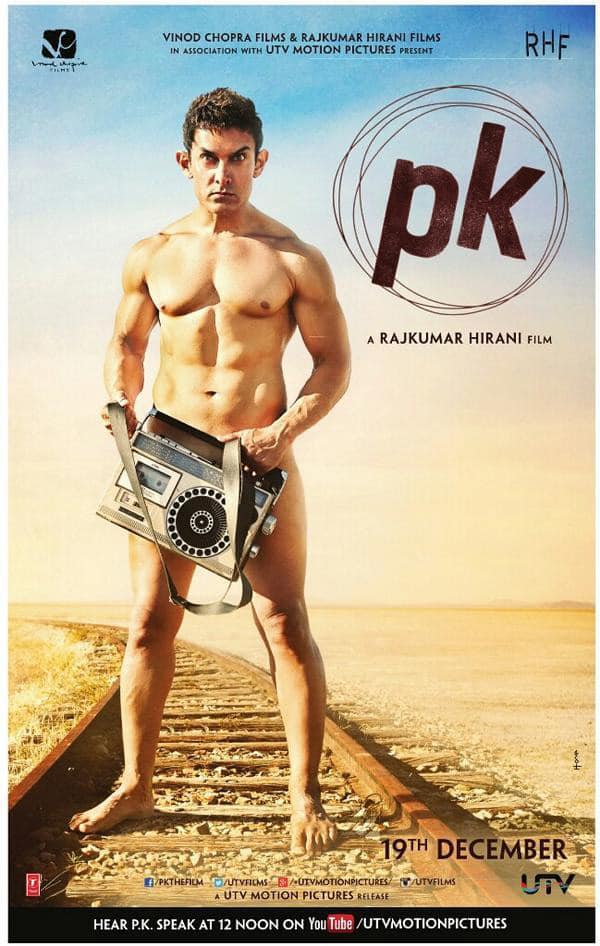
What is so obscene or vulgar in this PK poster?

Recently the poster of Raju Hirani and Amir Khan's upcoming movie PK was released. I am sharing the poster below for readers to see so that they understand what I am talking about.

Now I don't understand what is there is this poster to term as obscene or vulgar or against Indian culture? How this poster is any different than many undergarment ads that we see posted on big hoardings, displayed in many magazines, and played on TV? I am sure people who are attacking this poster or objecting to it in the name of an attack on their culture are doing so just for the sake of getting some media coverage. I also wonder if there could have been a similar reaction if this would not have been Amir's movie? They all (especially political parties) know that as Amir is a big star and any news related to his movie is bound to catch media attention, they want to encash this opportunity and grab media headlines. Male or female nudity is not new to any culture, there are nude statues in Khajuraho and also in many other parts of the world. Many people visit all these places, so I am sure as Indians we are not strangers to these types of images. In the era of the internet and smartphones where one can browse any website on their mobile phone what are these people trying to achieve by objecting to these posters? This poster is purely for the promotion of a movie and there is no intent to offend anyone, it is as simple as that. There is also a question of artistic freedom in this, as artists these movie makers are free to display their art within the allowed legal framework. If they are not breaking any law then I wonder why these people are objecting to it, and if they want to object they should take the matter to the court. Sadly it will be a waste of the court's valuable time as there are already many important matters pending for years in Indian courts but that will be a more logical route rather than protesting on the road.

There is another issue of objectification of the male body involved in this and this is a somewhat concerning issue. Already objectification of women is very common in movies and advertising. So, this question needs some attention but no one seems to be asking this, everyone is focused on obscenity or vulgarity or how this is against Indian culture. Except for the point of objectification of the male body, nothing else sounds objectionable to me. Any culture that survived for thousands of years is not so weak that it will get threatened by a movie poster. 

I was also surprised to see that some leaders from political parties also joined protests against this poster. They are doing this to get some publicity and media headlines. Many more important issues in India need urgent attention from these political parties and their leaders and this is definitely not one of them. This poster is just for the promotion of the movie, many people are just going to laugh at it or ignore it. People who don't like this poster or have some objection to it are free not to watch the movie. I don't think there is a need to create any controversy over this. We have many other serious issues which need our attention and time so let's focus on that.

Thanks for reading and please share your views on this topic.

[Copyright: Vinay Thakur. Please contact the author for re-posting or publishing]

Monday, August 4, 2014

Please don't mess up with education

Recent news about the introduction of some of Dinanath Batra's books in the recommended reading list for primary and secondary schools in the state of Gujarat created a lot of controversy. Name of Mr. Batra is very well known in the circles of Rashtriya Swayamsevak Sangh (RSS) and BJP, he was General Secretary of Vidya Bharati, the school network run by RSS. He is a retired school teacher and now claims to be an educational activist. It seems the purpose of introducing his books for recommended reading is to instill national pride, self-esteem, and cultural identity among students. There is nothing wrong in teaching students about their ancient culture, and presenting them with facts and figures from the past but do these recommended books do this in an unbiased manner? Mr. Batra's links with RSS or BJP should not be the issue here, his books should be discussed without any bias or prejudice. Whenever things are presented with some bias, there is selective appropriation. I feel that authors of some of these books (including Mr. Batra) try to do selective appropriation and their views present only one side of the story. They try to present Indian culture in a very narrow way, only the selected era from the past is defined as Indian tradition. These authors try to pick up very selective points and try to paint things either in a positive or negative way rather than giving a comprehensive view. Selective appropriation of facts often projects a one-sided image. This type of material is not appropriate for kids of so young age, and if they are presented with such things then it obviously creates doubts about the real intention behind this plan.

Only exposing one person's (or one-sided) view to highly impressionable minds presents its own dangers. Every society's history has some positive and some negative points, and we need to present both of them as objectively as we can. Religion, culture, and traditions have been used by many governments to propagate their own ideology. After all, politics and religion are about controlling people's minds and education is a very good resource to achieve this. This approach poses a danger of producing conditioned and biased thinkers rather than free thinkers. Decolonization of Indian education is necessary but that should not mean de-westernization. There is a need for open debate on this issue where all viewpoints are considered. People like Mr. Batra definitely have the right to express their views and concerns, their points should be taken into account, merits and demerits of all proposals should be discussed before making any final decisions. Educational institutes are a very important aspect of any society, and the government should not mess with them. These institutes should not be used to push any particular agenda, they should not be a tool in the government's hands. Imposing any language (like Sanskrit) or any culture (Hinduism) is not the way to Indianize the education system, there must be a better way of doing all these things without imposing anything on students which might affect their confidence.  Students should be made aware of the good parts of their culture as well as the bad parts of it so that they learn good values and don't repeat the same mistakes. Pluralism and diversity in India are part of its glorious culture, one cannot ignore this aspect of India's culture. I guess this is one of the reasons why there are some strong voices against the introduction of such books in schools.

India has a very rich cultural heritage. Some things mentioned in these books like cars were invented in the Vedik period or Ram traveled in the Pushpak airplane (implying that the airplane was first invented in ancient India), are factually wrong and can create very wrong impressions in student's minds. One should not mix mythology with history or science as it will harm the scientific aptitude of students. I am sure the Gujarat government doesn't want to raise a generation of misinformed students who have a false sense of cultural pride and are devoid of any scientific aptitude. This issue has attracted so much attention because the current prime minister Mr. Narendra Modi has written forewords to some of his books recommending them to current students. He did this when he was chief minister of Gujarat and as he is now the PM of India people think that this agenda might be implemented on a national level. I hope the think tank in BJP would not do this considering the resistance they might face nationally but as they have an absolute majority in parliament concerns of the people are valid. My only hope is that some better sense prevails in all concerned authorities and they stop messing with the education. 

Thanks for reading and please share your views on this topic.

[Copyright: Vinay Thakur. Please contact the author for re-posting or publishing]

Wednesday, July 9, 2014

Patriarchy is one of the oldest surviving ideology

The title of the blog is from a sentence taken from this video which delivers another tight slap on the world's, especially India's patriarchal culture. I really don't know how many slaps like this our society needs to wake up and realize that our culture is outdated and we need to change. Actually, it would be unfair to blame only India for having a patriarchal society or culture, it is prevalent more or less in all parts of the world, but I am going to discuss this only about Indian society as I come from that society and can comment about it based on my personal experience. In ancient times when the development in science was not much, most jobs or even day-to-day tasks used to require a lot of physical stamina and power men became superior in every society due to their physical strength compared to women. This superior physical strength gave them a natural advantage and dominance, they seized this advantage and made all rules and traditions which heavily suited them. Patriarchy is dominant in all cultures and religions. This natural advantage allowed men to design society as per their own needs and slowly role of women was reduced to support them, satisfy their needs, and help in reproduction. This system continued for many many years until we saw the emergence of feminist movements where women started demanding fair and equal treatment. For many cultures this demand for equality was a shocker, they couldn't believe that women could demand something like this, and this is why feminists are still targeted all over the world, to protect patriarchy.

Some people might ask the question, what is wrong with patriarchal ideology? Why do we want to change this ancient culture? Patriarchy has been going on for years and society survived with those values and customs so why do we need to change? Actually, even today many people want to preserve or continue with these types of traditions in the name of culture or religion, they defend them because this thing was invented by their great-forefathers. They believe that as their forefathers were very farsighted and intelligent so how can anything practised by them be bad? Somehow they fail to see that these practices are discriminatory and biased in nature, most of these traditions favor men and put women and other genders at the receiving end with unequal rights. Just because something is old is not a good reason to discard anything, one has to evaluate and test before making any decision. If the system is old, seriously malfunctioning, and harmful to certain sections of society then definitely we need to discard it. A system that treats nearly half of our population as secondary citizens definitely needs to go, no matter how old it is.

This patriarchal culture is directly or indirectly responsible for many traditions or rules that are biased against women. These types of rules are present in every culture and religion. Their influence is so strong that not only men but many women also defend them and oppose any reforms. Because of years of suppression, women are brainwashed to believe that they are the weaker sex and need the presence of men in their lives for protection and survival in our society. This all needs to change, but this change is not easy, as even many women believe that by nature they are inferior to men and they have to be dependent on men for social recognition. It will take a lot of awareness to change this mentality, challenging any age-old belief is not an easy task. Consistent efforts from feminist groups and more participation of women are necessary to make this possible. As long as women don't help themselves no amount of external help will be enough to elevate their status in society. the fight for equality is not easy and equality comes at a cost and women need to be ready for that. Women need to prepare themselves to bear this cost and carry the burden of responsibility that comes along with this, if not, then patriarchy is here to stay forever. If women are not willing to take control of their own lives, men will keep their control of almost every aspect of their lives, this is what patriarchy is. Patriarchy is as strong as organized religion, and it is an integral part of every religion. During the past few decades, feminist movements have made a big dent in it due to their consistent efforts but still lot needs to be done. I am glad to see that many women are coming forward now to challenge patriarchy, this is a good sign. Patriarchy might be one of the oldest surviving ideologies but the time has come for it to go. Just imagine lifting barriers from the minds of half of the world's population, imagine lifting the burden of '"being a man" from the minds of other half of the world's population. People will be free from social pressure to fit into stereotypes associated with their gender. If this happens it will be one of the greatest events in the history of human civilization. With our consistent efforts I am sure this will happen, so let's keep trying.

Thanks for reading and please share your views on this topic.

[Copyright: Vinay Thakur. Please contact the author for re-posting or publishing]

Links:
1. A Group Of Women Speaks Up To Send A Very Powerful Message To The Indian Male Dominated Society

Friday, June 27, 2014

Which culture Dr. Harsh Vardhan is talking about?

India's union health minister Dr. Harsh Vardhan during one of the interviews made a statement that the thrust of the AIDS campaign should not be only on the use of condoms as according to him it sends the wrong message that "you can have any kind of illicit sexual relationship, but as long as you're using a condom, it's fine." It seems he also said that citizens' moral fiber will have to be strengthened if the disease has to be brought under control. He also stressed promoting the integrity of the sexual relationship between husband and wife as a part of Indian culture. Now, what does he mean by Indian culture? In a diverse country like India, terms like morality and culture have different meanings and have different sets of values in different parts of the country. Even Hindu scriptures like Ramayan, and Mahabharat openly propagate polygamy and polyandry. Most kings we studied in history books had multiple wives, in most stories that I heard as a child kings used to have at least two wives one favorite one and another not-so-favorite one. In India we have Khajuraho temples where there are sculptures of people engaged in sexual acts, Kamasutra was written in India thousands of years back. So which culture is he talking about? I also wonder how he is trying to link the encouragement of the use of condoms with the encouragement to have illicit sexual relationships. I am still trying to figure out the logic of this connection. Encouragement to use seat belts while driving is not an encouragement to drive but it is an encouragement to be safe whenever you drive. It just means use that seat belt whenever you drive a car, it's safe, it saves lives, and it is good for you and your family. The argument is not about driving but about driver's safety and safe driving. How hard it is to understand? 

In a pluralistic country like India different regions subscribe to different cultural values and traditions. Even in today's world people's religion, and caste play a very important role in constituting their cultural values. In some parts of the world, polygamy is legal. In India, polygamy or polyandry is practiced even though there are laws against it. Dr. Harsh Vardhan is the union health minister, and his main job is to spread awareness about issues related to health. The Spread of HIV is one of the major concerns for the health ministry and sex education is one of the important tools to spread awareness about AIDS and HIV. The main reasons attributed to the spread of HIV in India are extensive labor migration (where people migrate to cities without their families), low literacy levels, and lack of awareness about issues related to sexual health. The use of intravenous drugs and prostitution are also considered major factors that contribute to the spreading of HIV. Now if we look at all these factors there is very little that culture can do to stop the spread of HIV, even prostitution is considered part of every culture as this profession is considered one of the oldest and has been a part of human history for ages. As cultural values are so diverse and drastically vary from region to region or even from family to family it is not a good idea for the health ministry to depend on them for spreading awareness about serious health issues like AIDS. Sexual relationships are personal matters. Each adult has the right to choose their sexual partner, the government or culture cannot dictate these things, there are already laws that dictate the minimum age for having consensual sex and marriage. The health ministry must spread awareness about these issues without going into too much into the cultural aspect of it. The government can try to spread awareness about the benefits of having a single sexual partner, honesty in relationships, and the advantages of using condoms and other contraceptives. They should not complicate it or make it controversial by bringing unnecessary cultural aspects into it. After all, personal health is an important aspect of everyone's life, culture or no culture, public health must be a national concern.

I am sure Dr. Harsh Vardhan's intentions were good behind making this statement Maybe his years of training in RSS or BJP have created an impression in his mind that all Indians follow the same culture and that culture is related to their interpretation of Hinduism but this is not true and as a health minister of India he needs to understand this. I hope he will be more careful when he talks about health-related issues in the future and will use his medical knowledge more rather than using his teaching from RSS or his own culture. Bringing unrelated issues like culture into health will only confuse people. There is enough scientific data available about many health-related topics just use that data to spread awareness, run very aggressive campaigns, and try to develop infrastructure so that the public health department is better equipped to deal with these issues. If he can do this India will definitely see improvement in the sector of public health irrespective of its culture.  

Thanks for reading and please share your views on this topic.

[Copyright: Vinay Thakur. Please contact the author for re-posting or publishing]

Links:
1. Don't wear a condom, wear values to fight AIDS: Harsh Vardhan
2. Harsh Vardhan clarifies on ban on sex education in schools